4361 he.
The Kamanos Raised Bog and all the woods surrounding the bog were attributed to the Kamanos Botanical Reserve established in 1960 and covered 5,094 ha. When establishing the Kamanos State Strict Nature Reserve, the bog was separated from the woods leaving a portion thereof in the protection zone of the strict reserve. The purpose behind establishing the Kamanos Strict Reserve was to preserve the Kamanos wetland – the largest wetland complex in northern Lithuania with interior areas of dry land (islands and peninsulas), bog pools encircled by sloughs, as well as the nearby Didmiškis Forest with the typical and rare plant and animal species. The Kamanos Raised Bog has been included in the list of sites protected under the Ramsar Convention. The strict reserve has also become a part of the European network of the protected areas Natura 2000. The territory of the strict nature reserve has been approved as a Territory important for bird protection and included into the List of the Potential territories important for habitat protection.
The uniqueness of the territory starts with the deepest strata. Over thousands of years, the marsh has built up a high peat canopy of distinct wetland centres, eight shallow lakes nestled in the lowlands between the ridges. As the vegetative deposits accumulated, the individual bogs grew taller and taller until they merged into one large mass. The tops of the ridges drowned by the marsh have formed open ravines with complexes of lakes, mesas and washes. Their abundance and diversity is exceptional throughout Lithuania. The flats are important for breeding rare birds of the moor (teal, tits, tits, grouse), and their populations in Kamany bog are characterised by stability. The area is distinguished from other reserves by species with a restricted distribution, which are unique to northern Lithuania (Blue-headed Vixen, Avette's Teasel, Varied-leaved Thistle, Blue-headed Blue-cheeked Fritillary, and Bubblers).
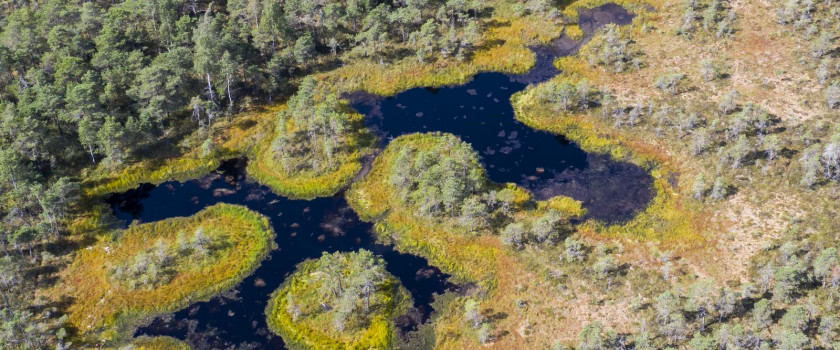
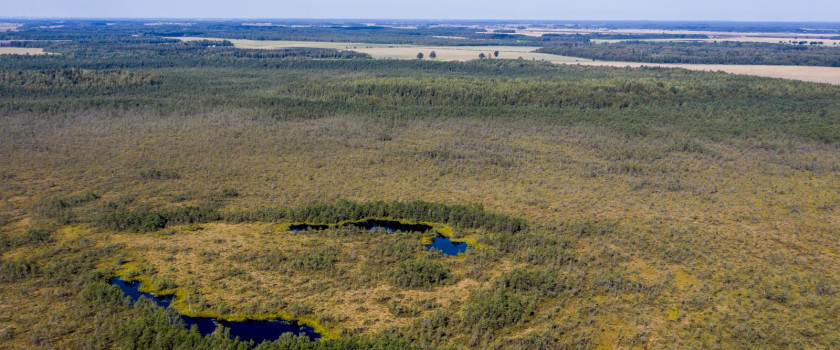
The Kamanos Strict Reserve is the largest wetland complex in northern Lithuania surrounded by agrarian land and consisting of the Kamanos wetland (2,434 ha), the adjoining Adomiškės Raised Bog (94 ha) and the nearby forests. The retreat of the last glacier left concentric chains of morainic landforms as it melted. The Kamanos wetland started to form in the Venta River midsection approximately 11,000-12,000 years ago. The fens that developed in the inter-ridge areas gradually formed a raised bog which grew over the top of 6 morainic ridges to form one continuous wetland. The former ridges now appear as islands and peninsulas. The average peat layer thickness is 3.8 m, reaching a maximum of 7.2 m in some places. The most interesting formation in the raised bog include wetland “eyes” and bog pools surrounded by hard to enter sloughs. There are over 120 bog pools in the 12 Kamanos ponds. The largest Kamanos Lake (6,2 ha) is located on the northern part od the wetland. The Pragalvis Stream and the smaller tributaries of the Venta River rush from the southern end, Ašva and Purvas Rivers from the western end, and, and the tributaries feeding the Agluona River flow out from the eastern part of the wetland.
Kamanos Bog is situated on the watershed of the Venta, Ašva and Agluona River basins characterised by low gradient. Back in the 19th century, ditches were made with the Kamanos Raised Bog ponds Swans rest in the Kamanos Lake during their migration period 45 network of the ditches being constantly expanded. In the early 20th century, the ditches were dug till the very Kamanos Lake resulting in significant sinking of the lake. The original ditches were renewed, and new ones were made in the 1980s and 1990s to drain the forests. These ditches have been dammed in many places to restore the hydrological regimen of the wetland. During the years 2015- 2016 only, over 37 km of ditches have been dammed in the reserve by setting up over 300 dams as a result of the implementation of the European Union LIFE+ programme project No. LIFE13 NAT/LT/84 “Restoration of proper hydrological conditions in Amalva and Kamanos bogs”.
Despite its location amidst large industrial centres (the Mažeikiai oil refinery and the Naujoji Akmenė concrete manufacturer) and intensely cultivated agricultural fields, this strict reserve has retained many relict and rare plant species and rich diversity of animal species. The largest raised bog areas of the Kamanos Strict Reserve are dominated by Ledo pinetum pine forests with low pines with Rhododendron tomentosum, Calluna vulgaris, and Rubus chamaemorus thickets. Sphagnum moss is the main moss covering the open tree-less plains, whereas cranberries, Calluna vulgaris, and Eriophorum dominate the sparse shrubbery and grass storey. The wetland is surrounded by forests which cover more than a half of the strict reserve area. Acidic swamp decidous woods, swampy coniferous forests and mixed swamp woods dominate the wetland surrounding areas. The mineralised soil has given rise to species-rich mixed forests. In the Kamanos bog surrounding areas and former homestead sites, there are still old mighty oaks remaining. Former farmstead sites have retained plots of semi-natural grasslands which serve as a shelter for many rare plants. Ancient woodlands located at the edge of the raised bog.
The most common communities growing in the interesting bog rips are Sphagno tenelli-Rhynchosporetum albae dominated by Rhynchospora alba and Drosera anglina. The rare Spoonleaf Sundew (Drosera intermedia) is found in the raised bog, the rapidly disappearing Bog Orchid (Hammarbya paludosa) can still be noticed in transition mires, while in the grasslands the Military Orchid (Orchis militaris) and other species can be found. The Kamanos wetland habitats are characterised by their great diversity – they are active and relatively unaffected raised bogs adorned with slough and bog pool complexes, and complex transition mires and quaking bogs found in small plots throughout the wetland.
Biological diversity
The reserve contains 12 types of natural habitats of European Community importance. They cover almost the entire bog and a large part of the boggy forest. The largest areas (in descending order) are: swamp forests (code 91D0), active raised bogs (7110), herbaceous spruce forests (9050), swamp deciduous forests (9080), bogs of peaty substrate (7150), western taiga (9010), intermediate marshes and lagoons (7140).
By 2020, 419 species of fungi and lichens, 975 species of plants, and 2 589 species of animals had been recorded in the Kamanos State Strict Nature Reserve. The large and diverse plant kingdom consists of 670 species of vascular plants, 133 species of mosses and 172 species of algae. The Lithuanian Red Data Book includes 26 species of vascular plants and 6 species of mosses. One species, the broadleaved clematis, is particularly protected and is listed under the European Union's Habitats and Wildlife Directive. The fungi kingdom consists of 244 species of fungi and 175 species of lichens. 3 species of fungi and 2 species of lichens are listed in the Lithuanian Red Data Book.
Invertebrates are the most abundant group of fauna in the world (2 333 species), 16 of which are listed in the Lithuanian Red Data Book. Beetles (1,029 species), butterflies (536), dung beetles (306) and bipterans (249) are the most abundant species. Beetles listed in the Lithuanian Red Data Book are found in the Reserve: the brass ornate beetle, the marbled golden beetle and the large sky beetle. Kamanos State Strict Nature Reserve is an important place for the protection of rare vipers - the white-backed and golden-cheeked shrikes. Small lakes are home to the rare horses, the armoured and white-necked skylark.
6 fish species have been found in the waters of the Reserve. Only perch and pike swim in Kamana Lake. Other fish were found in the ditches, including the common crayfish, which is listed in the Lithuanian Red Data Book. The reserve is home to 3 reptile and 7 amphibian species. The scaly newt is listed in the Lithuanian Red Data Book.
The Reserve is home to 190 bird species and 50 mammal species, of which 49 and 6 are listed in the Lithuanian Red Data Book. During migration, flocks of greylag, white-fronted, lesser white-fronted geese, cranes, and during the breeding season, the rare ground squirrel can be seen on the moor, for which Kamana is one of the few breeding sites in the country. The reserve is also home to a large number of grouse, teal, and woodcock. Black storks, lesser spotted eagles and wasps breed in the forests. Many mammals also find excellent shelter in the reserve. Red deer and elk are among the most typical inhabitants of Kamana. White hares, rarely found elsewhere in Lithuania, breed here as well, a family of wolves, various species of bats, marmots, and lynxes live here regularly.
Rare species are also protected by the European Union's Birds and Habitats and Wild Fauna and Flora Directives. The Annexes to these Directives list 80 species of animals found in the Kamanos State Strict Nature Reserve.


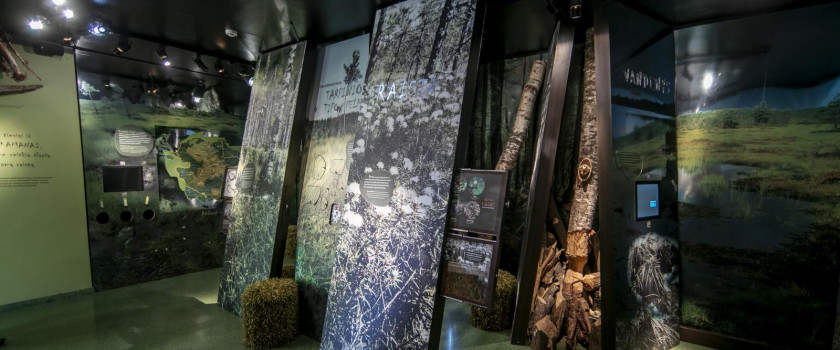
 Visitor centre
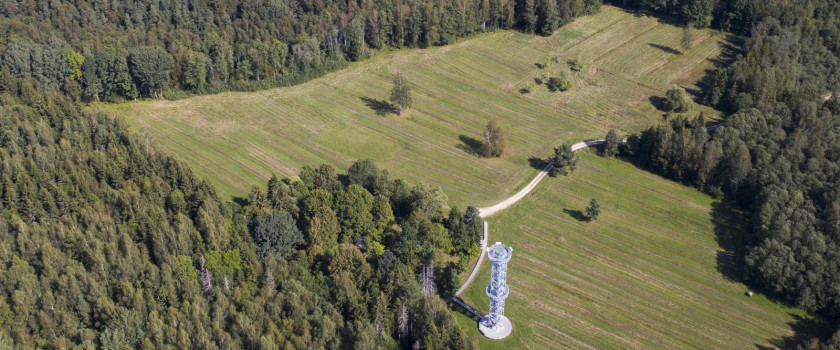
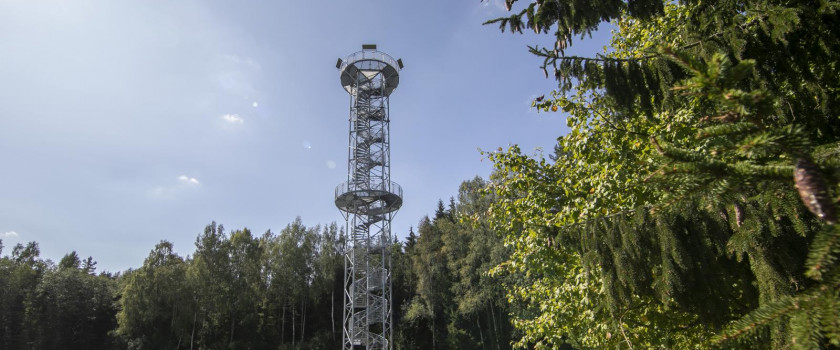
 View Tower
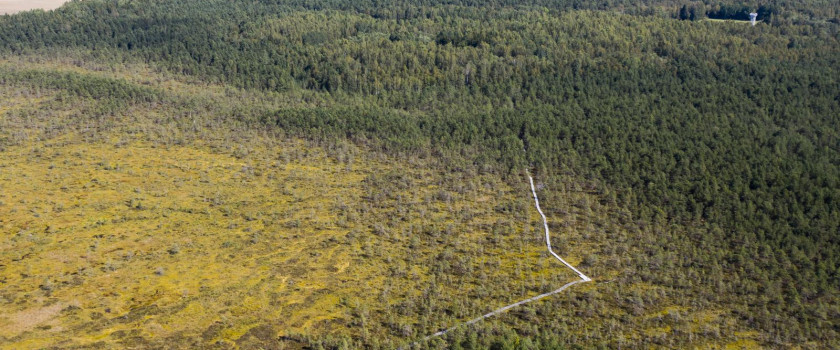
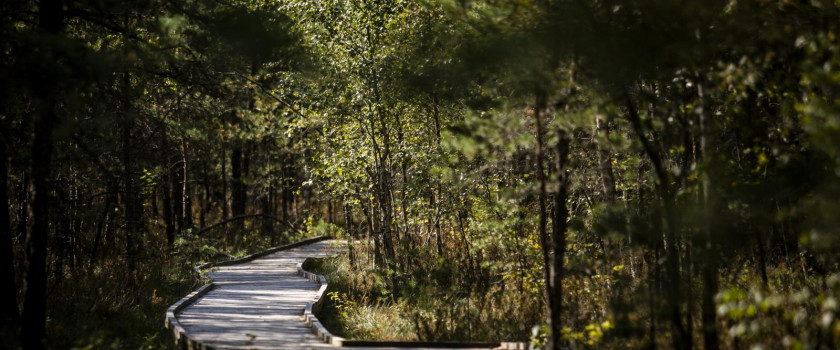
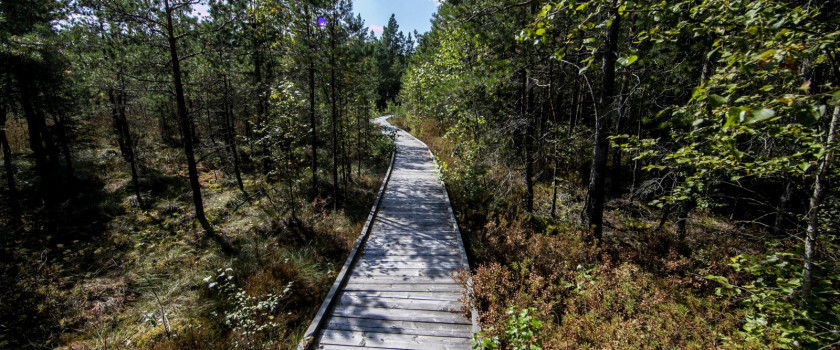
 Cognitive, educational trail

 Geological
 Geomorphologic
 Hydrogeological
 Hydrographic
 Botanical
 Zoological
 Nature school
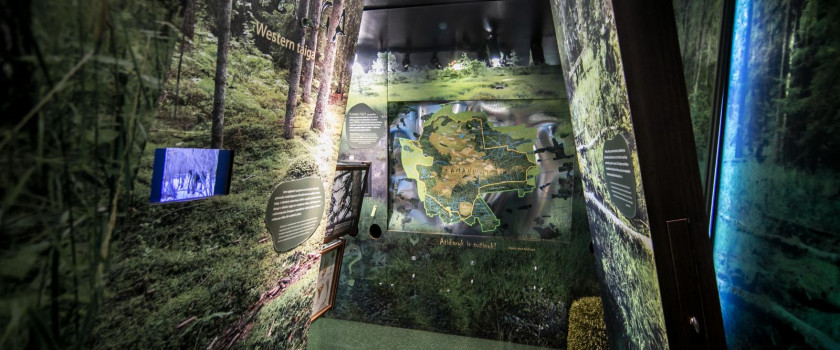
 Visitor centre
 Visitor centre
 View Tower
 Cognitive, educational trail

